Rebecca Alley
About me
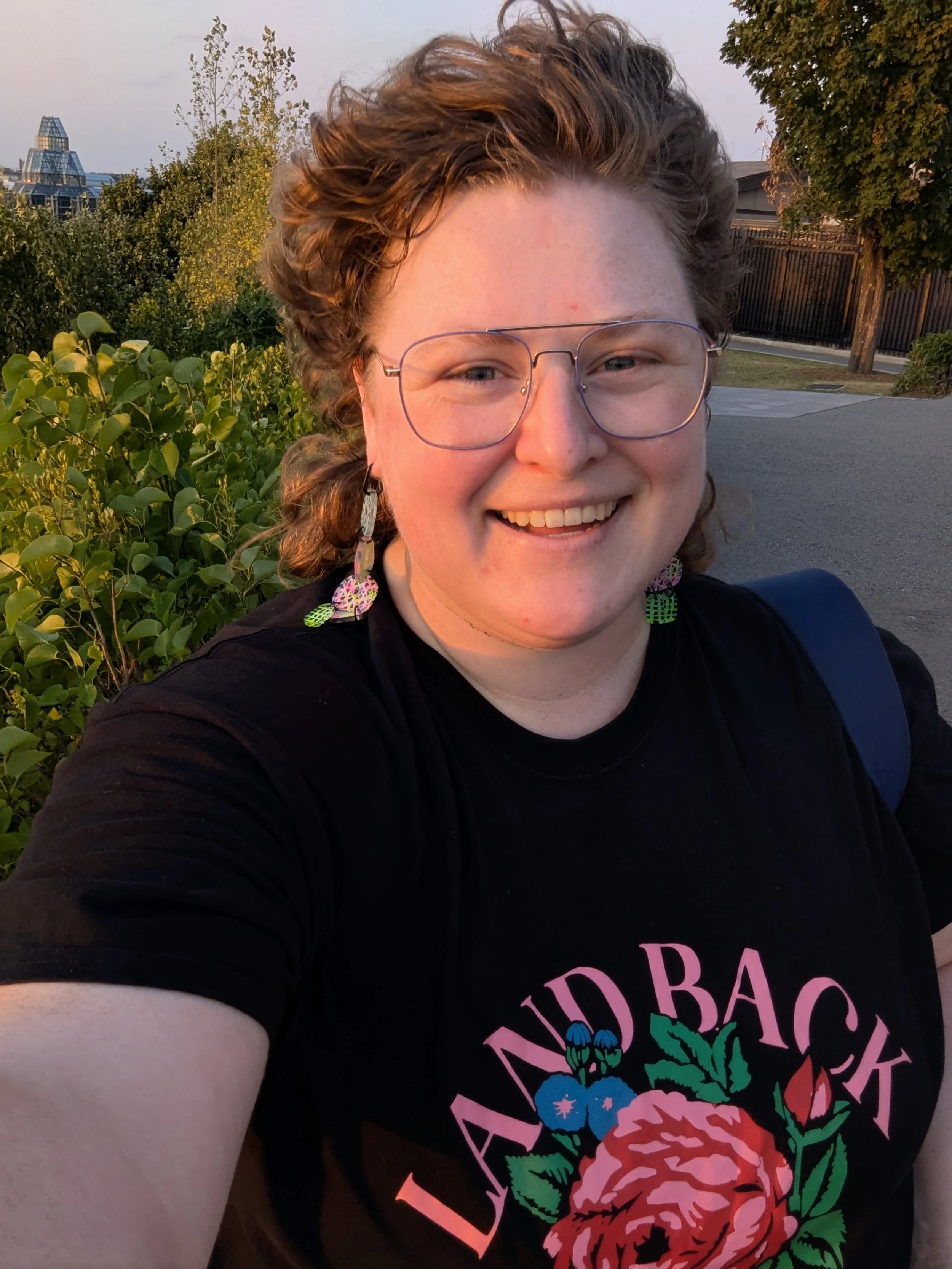
I am a queer and neurodivergent settler aunt, cat parent, learner, backpacker, friend, occupational therapist, teacher, paddler, and maker, who has been living in amiskwaciwaskahikan since 2019. I am from places across so-called Canada, but grew up in unceded Musqueam and Coast Salish territories in what is now known as Burnaby, Vancouver, and the southern Gulf Islands. I have a background as a coach in a variety of sports and started my career with a kinesiology degree before completing my master's degree in occupational therapy at the University of Manitoba. My capstone project there was a scoping review exploring healthcare accessibility for 2SLGBTQ+ folks in Canada, and advocacy for improved healthcare accessibility for my communities has remained important for me.
I am doing my PhD full time now (see below!) but continue to do small amounts of work with local nonprofits in the inner city in the realm of homelessness and/or supportive housing/housing transitions, and I teach in the M.Sc.OT program at the University of Alberta (basic theory and OT process. harm reduction and concurrent disorders, and sexuality; I also supervise students for their capstone projects and on Role Emerging Placements). Some fun facts about me: I have built the last 4 bicycles I have owned; my cats all have people names; I sing in two choirs; I think death and play are both incredibly important things that we don't talk about enough in healthcare; and I love Jam Club where friends and I preserve whatever locally foraged fruit is in our freezers while playing far-too-competitive Dutch Blitz during the processing time.
About my work
Although I started as an occupational therapist working in acute care, for most of my career I have worked in community addictions and mental health settings. I am angry about the health and social inequities that are apparent for folks who are living in poverty, inadequate housing, or experiencing homelessness, which only becomes worse for those at different intersections such as racialized or queer folks, those living with mental illness and/or addictions, or people who are otherwise disabled. I was tired of being consistently upset about seeing my clients repeatedly face the same barriers, so I decided to do a PhD about it. Now I can be upset while also doing a very small bit to work towards meso- and macro-level change more effectively than I am able to in frontline practice! I am particularly interested in how our systems can be made more accessible for folks who are homeless and living with cognitive impairment. As an occupational therapist the frequency with which cognitive impairment is present in this population was quite quickly apparent (and is increasingly reported in the literature!), but systems are not built to accommodate folks with impaired executive function, memory, attention, etc. The world can and should be a kinder place for everyone, especially community members who are doing so much with so, so little.
Email Rebecca: ralley@ualberta.ca
Other links